Dried Shiitake mushroom
SUGIMOTO
Why Was Shiitake Dried Under the Blazing Midsummer Sun?
Tag:
Table of Contents
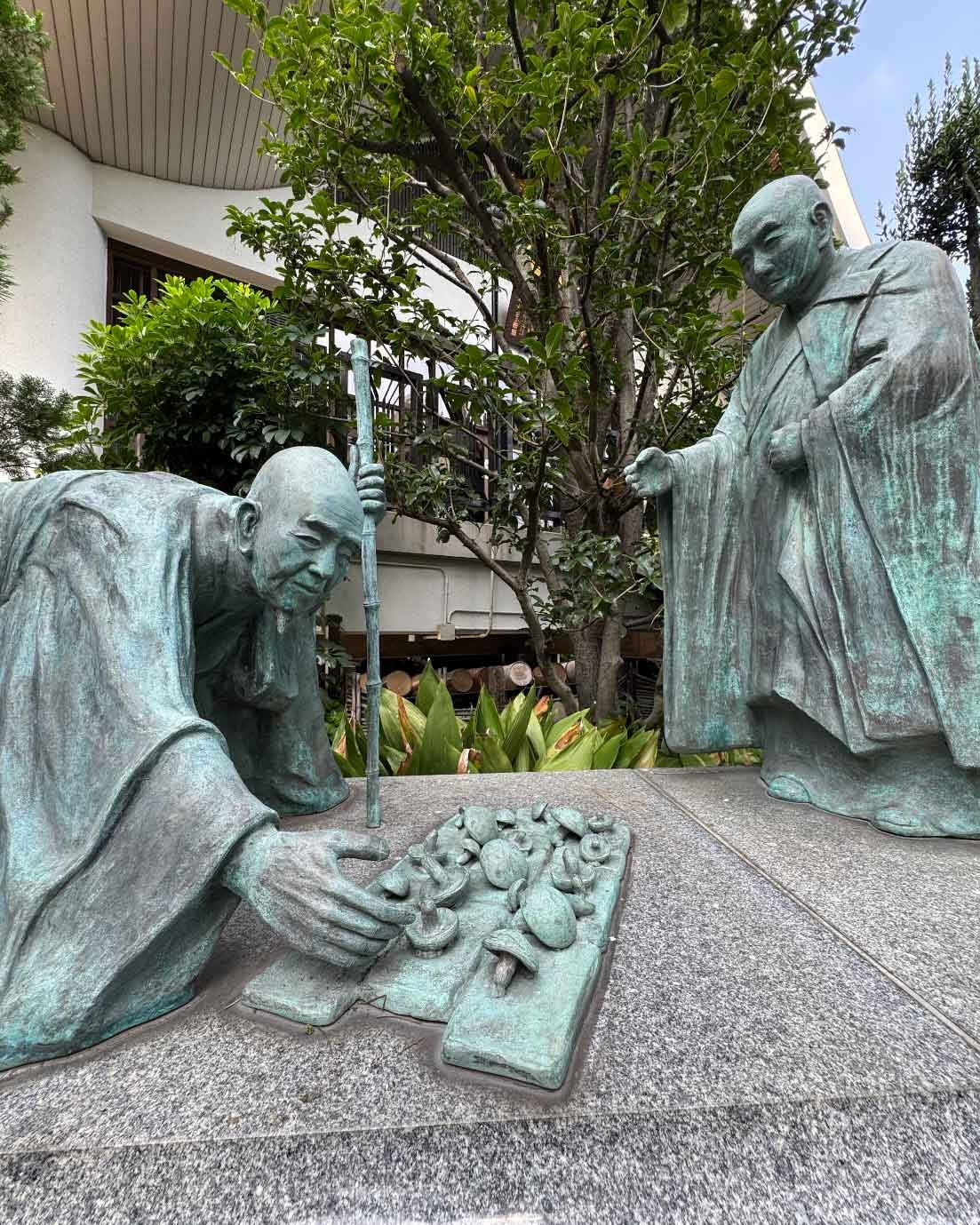
The Statue of Sun-Dried Shiitake
Have you ever seen a statue of shiitake being sun-dried?
This statue is unusual because it conveys not only a Zen teaching, but also old wisdom about how shiitake used to be dried.
It is based on a dialogue in Tenzo Kyokun between an elderly tenzo sun-drying shiitake under the blazing midsummer sun and the young Dogen Zenji.
In Tenzo Kyokun, there is a story about an elderly tenzo, the monk in charge of meals, sun-drying shiitake on roof tiles laid out on the ground under the scorching midsummer sun.
|
There are two key points:
|
Placing dried shiitake on roof tiles spread across the ground in midsummer and sun-drying them this way was a smart method, because heat reached the mushrooms from both above and below, allowing them to be dried thoroughly again.
Shiitake naturally fruit in two seasons, spring and autumn. So it is more natural to think that the midsummer work described in Tenzo Kyokun was not the process of drying fresh shiitake into dried shiitake, but rather sun-drying already dried shiitake to maintain the proper level of dryness.
This is not just an old story. It also connects to practical drying knowledge that continued into modern times.
A shiitake cultivation manual published in 1930 also recommends high-temperature drying, so in this blog post, I will read this story together with older drying methods.
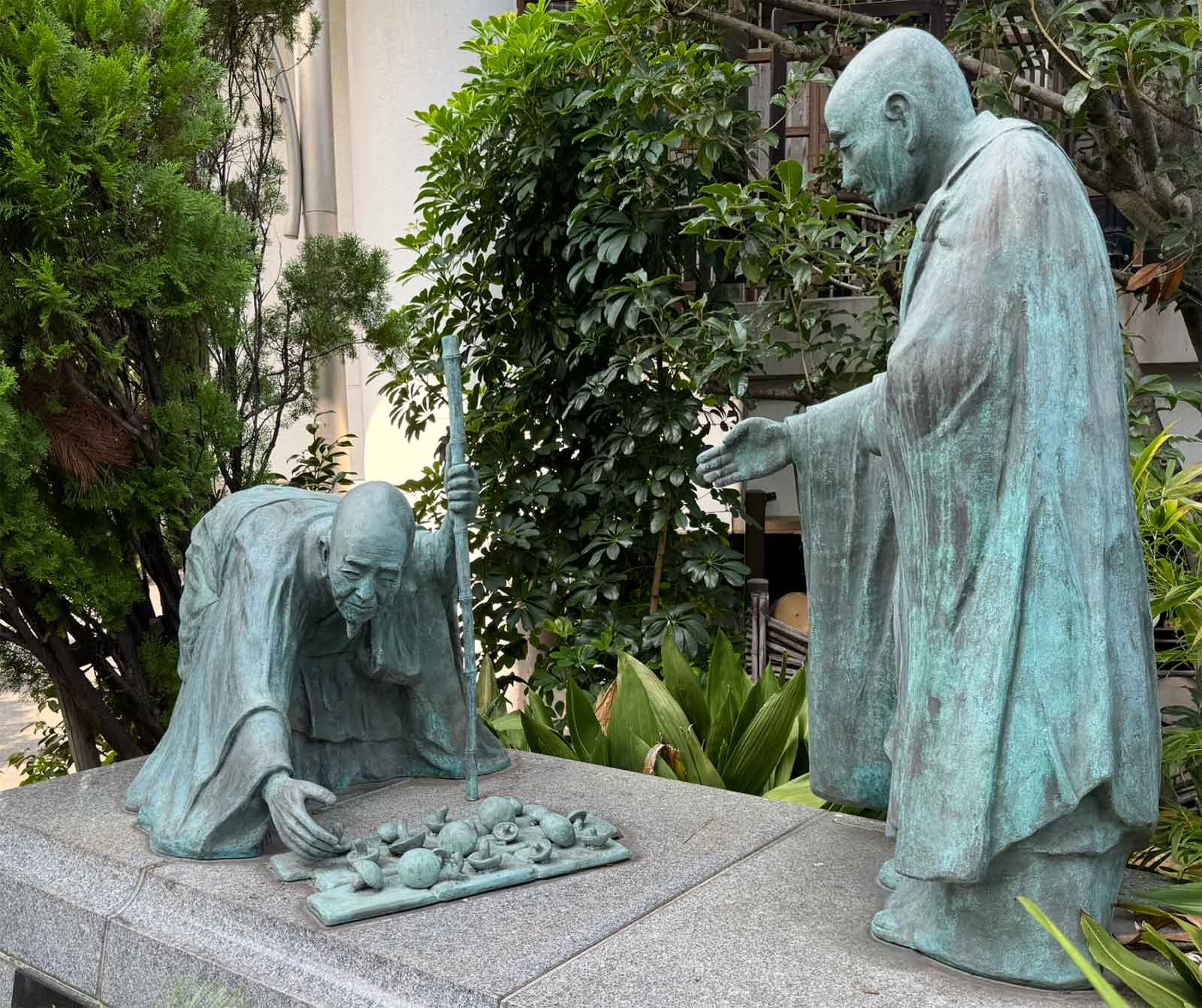
The photo shows “The Statue of Old Tenzo Oshō of Tiantong Mountain and the Young Dogen Zenji” at Dairyuji Temple in Shinjuku, Tokyo.
Modern English Rendering of the Inscription
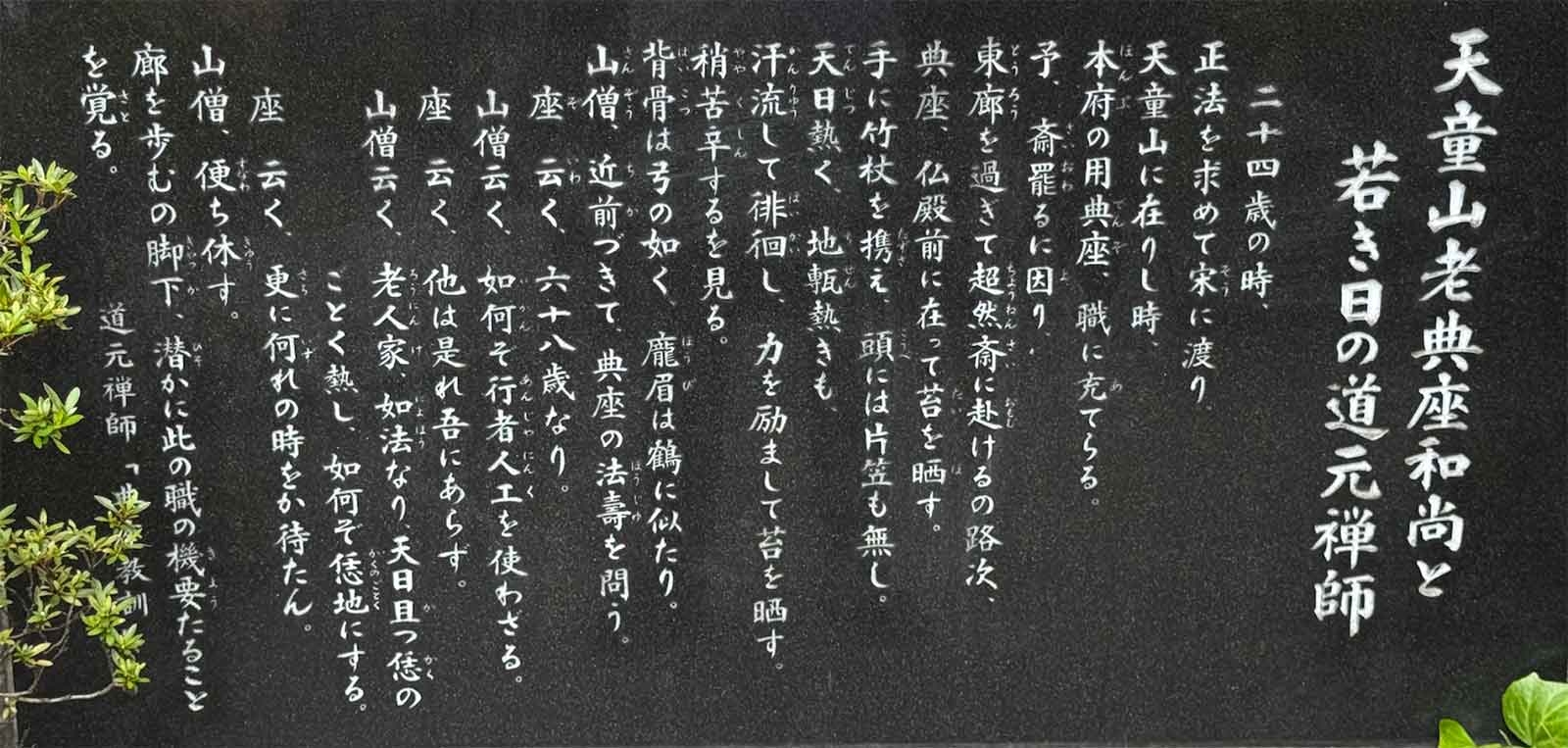
I rewrote the inscription on the statue in modern, easy-to-read English. It is natural to think that this episode took place about 800 years ago, around 1223. The reason is that the text says, “When he was twenty-four, after crossing to Song China in search of the true Dharma, while he was at Mount Tiantong.” Dogen is generally said to have been born in 1200, so a simple calculation places age twenty-four around 1223–1224.
-----------------------------------
This is a story from the time when Zen Master Dogen was twenty-four, after he had crossed to Song China in search of the Buddhist Way and was staying at Mount Tiantong.
While I was at Mount Tiantong, a monk named Yo from Ningbo Prefecture was serving as tenzo.
After finishing my meal, I was walking along the eastern corridor on my way to the Choran-sai residence when I saw Tenzo Yo drying shiitake in front of the Buddha Hall.
The tenzo held a bamboo staff and wore no hat.
The sun was strong, and the roof tiles spread out on the ground were also hot, yet he kept walking about in the heat, sweating and working hard to dry the shiitake, looking as though he was enduring great hardship.
His back was bent like a bow, and his eyebrows were as white as those of a crane.
I went up close and asked his age.
The tenzo replied, “I am sixty-eight years old.”
I said, “Why do you not have someone else do it?”
The tenzo replied, “Others are not me.”
I said, “What you are doing is truly admirable. But on such a hot day, why are you doing this in a place like this?”
The tenzo replied, “If not now, then when would I do it?”
At that, I fell silent.
As I walked along the corridor, I came to understand the essential meaning of this duty.
Modern Sun-Drying
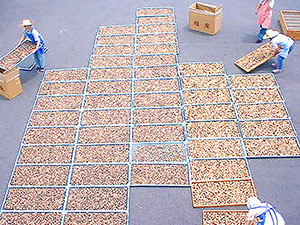
The photo shows Sugimoto’s sun-drying process as it was done in 2008. Today, we use a different method for safety reasons.
They were not roof tiles, but asphalt. The shiitake were laid out under the blazing midsummer sun.
Unless the shiitake were heated from both above and below, they would not dry thoroughly, so this kind of sun-drying could only be done in midsummer.
To avoid foreign-material contamination, this method has now been replaced with a finishing process that uses far-infrared drying and UV treatment, neither of which depends on the weather.
In production areas, high-temperature drying with firewood or charcoal had long been used, while sun-drying in consumer areas was a simple form of “re-drying” carried out in midsummer.
For more details: "UV rays increase Vitamin D!"
Shiitake Cultivation Guide Published in 1930
Back in the days before inoculated plugs were invented, shiitake were cultivated by cutting notches into logs with a hatchet. Moisture content is extremely important in dried foods.
Below is a modern rendering of the section on drying methods from Yama no Hikari, a shiitake cultivation guide published in 1930.
|
Key points from the 1930 guide Yama no Hikari
|
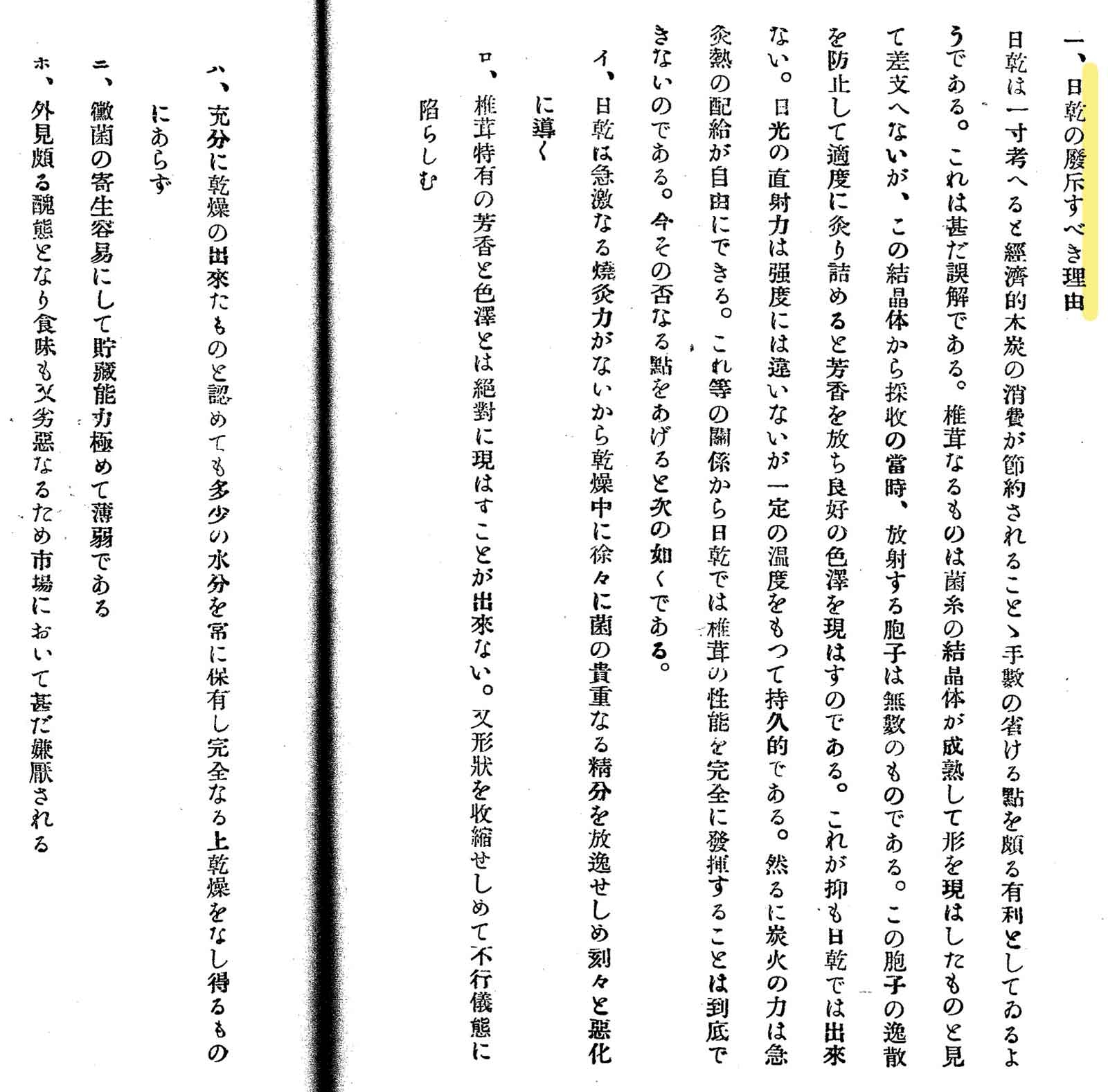
“The Light of the Mountains” (1930)
Modern English Rendering of Section 3 of Yama no Hikari
Section 3: Sun Drying and Heat Drying
-
Why Sun Drying Should Be Avoided
At first glance, sun drying may seem like an advantageous method because it saves charcoal and reduces labor. However, this is a serious misunderstanding.
Shiitake may be understood as having taken shape after the fungal body has matured, and countless spores are released around the time of harvest from that formed body.
If the scattering of these spores is prevented and the mushrooms are finished with appropriate heating, they develop a good aroma and beautiful color. But this cannot be achieved through sun drying alone. The direct force of sunlight is certainly strong and can continue at a steady temperature. Charcoal fire, however, can supply strong heat freely as needed.
Because of this difference, sun drying cannot fully bring out the best qualities of shiitake.
Its drawbacks can be summarized as follows.
A. Because sun drying lacks strong heat, important components are gradually lost during the drying process, and quality steadily deteriorates.
B. It cannot fully bring out shiitake’s distinctive aroma and color. The mushrooms also shrink, and their appearance becomes poor.
C. Even when they appear sufficiently dry, they still tend to retain some moisture and do not become completely dried.
D. Mold can grow easily, and shelf stability is extremely low.
E. Their appearance becomes very poor, and their flavor also declines, so they are strongly disliked in the marketplace.
These defects cannot be restored even if the mushrooms are further heat-dried after sun drying. The degree of dryness may improve, but the quality itself remains inferior.
For example, if mushrooms that were first sun-dried for a time and then finished with heat are compared with mushrooms that were heat-dried from the very beginning, even a non-expert can immediately see the negative effect on quality.
The idea that “a little sun drying is probably fine” must therefore be firmly rejected.
Some people also say that sun drying increases the weight. But this is a very shallow way of thinking.
It may indeed appear heavier at first glance, but that is only because of the moisture that remains inside. If judged as a properly dried finished product, then in principle it is actually inferior to a heat-dried one.
Therefore, in order to protect the value and reputation of this important domestic product, sun drying must absolutely be avoided.
It is even said that in Oita Prefecture, strict rules were introduced to discourage sun drying as much as possible, and that the practice was improved to the point that violators were fined.
-
The Benefits of Heat Drying
The improved drying methods encouraged today are all rational methods, so the heat can be freely controlled.
As a result, proper drying work can be carried out, and if a skilled dryer fully applies that skill, it becomes possible to produce almost perfectly high-quality shiitake.
The advantages of heat drying are as follows.
A. Because heat can be freely controlled by hand, careful adjustment prevents the loss of the mushroom’s important components.
B. By adjusting the heat, it is possible to fully bring out shiitake’s three important qualities: aroma, color, and good shape.
C. Because the mushrooms can be thoroughly dried and properly finished, there is no opportunity for mold to grow, and they can withstand long-term storage.
D. Their appearance becomes very attractive, the aroma becomes rich, and they take on a beautiful golden-yellow color, resulting in a rich flavor that many people enjoy.
E. In the market, they consistently command high prices and sell very well.
Of course, producing a high-quality product by heat drying requires effort, skill, and some materials such as charcoal. However, that burden is more than compensated for in the selling price.
For that reason, we should not be distracted by small short-term profits, and from the standpoint of improving the quality of domestic shiitake, we must take heat drying seriously.
The specialty products of Oita and Miyazaki, which are leading shiitake-producing regions in Japan, have devoted careful attention to this point and have continued to improve and develop. That is why they are now held in such high regard around the world.
For a record of shiitake cultivation in 1930, when Yama no Hikari was published, see below:
How to Sun-Dry at Home
Dried shiitake mushrooms produce plenty of vitamin D when exposed to UV light. Here’s how to make dried shiitake even richer in vitamin D by sun-drying them at home.
Spread the dried shiitake mushrooms on a sieve or similar so they don't overlap.
Expose them to sunlight with the stems facing up. Depending on the need, sun-dry for about 30 minutes to 3 hours. There is an effect even in a short time, but the longer you expose them, the more effective it is. If the UV forecast is "strong 6" or more, one hour of sun-drying is enough. The amount of UV varies by season, so adjust accordingly. If you're drying out humidified dried shiitake mushrooms, sun-dry them until they're completely dry.
After being exposed to strong sunlight, the underside of the dried shiitake mushroom cap will turn whitish. This is proof that sufficient UV rays have been received, so if it turns white, sun-drying is complete.
Allow them to cool sufficiently before putting them in a bag. If you put them in a polybag or similar while they're still hot from sun-drying, they will condense inside the bag.
By following the above steps, you can enjoy the best sun-dried shiitake mushrooms at home.
Learn more:
Share this page on SNS.